What goes into a People Also Ask brief
- Keep the seed query, market, date and answer source with each question.
- Give questions that call for the same answer one section.
- Specify the evidence and acceptance check for each section.
- Keep unresolved questions in the worksheet with a reason and a next step.
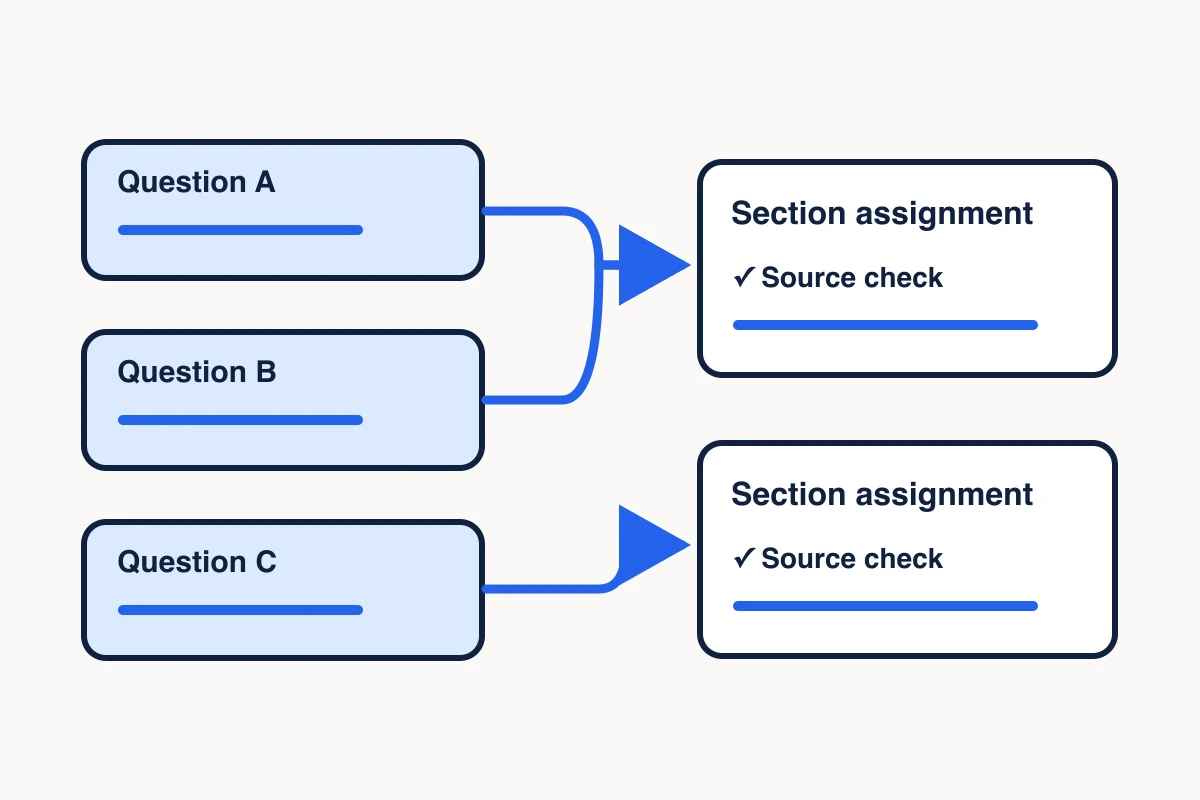
Start with one page and one decision the reader needs to make. Collect Google People Also Ask questions, group the ones that need the same answer, and check the pages behind the answer cards. Give the writer a section assignment and a way to check each answer. The result is a brief a writer can use without repeating the research.
Capture People Also Ask questions with their search context
People Also Ask is the group of expandable questions that can appear in Google results. Start from a query that represents your page's job. If the job is to help a marketer choose a scraper for an AI workflow, start with that job in the query. Capture the question as shown, the original query, the locale and device if known, the date, and the source URL displayed with the expanded answer.
For a few questions, expand the cards in Google and log them in a sheet. For a repeatable collection workflow, use MCP Scraper's harvest_paa_start with a bounded question target, then check the same job with harvest_paa_status. Record the returned count and the completion state before you hand the results off. Mark questions with missing or incomplete answers so a writer can tell which citations still need checking. See the People Also Ask SEO guide for collection approaches.
Group People Also Ask questions by the decision they support
Group People Also Ask questions that require the same answer and evidence. For a guide about choosing an AI web scraper, “What are some good web scraping tools?” and a top-ten-tools variant can both inform one section on choosing a tool. The reader needs selection criteria that fit the task. Keep both wordings in the sheet so the writer can see the evidence behind the combined assignment.
Questions about current cost, permission to collect data, or how to run a first test need different evidence. Decide whether each helps the reader complete the page's main job. Assign a relevant question to a section, send an adjacent decision to the page that covers it, or park it with an explicit evidence requirement. Repeated appearances show recurrence in the captures you ran. Use a separate volume source if the publishing decision depends on search demand.
Verify the pages behind People Also Ask answers
A People Also Ask answer gives you a source to inspect. Open the linked page and note the exact statement you can support from it. A provider's homepage can establish how it describes its own product. A comparative claim about which product works better needs a test or a separate study with a clear scope. If you’re choosing a tool for briefs, use the same seed question to compare what each PAA tool returns. Check which outputs give your writer enough source information to verify the answer.
In a November 7 browser capture for “web scraping tools for AI workflows,” the expanded card “Is there an AI website scraping tool?” surfaced links to Browse AI and Firecrawl. Google displayed an AI-generated summary in the expanded card. The capture does not establish whether the summary was complete. Inspect the exact card receipt. The receipt records the observed answer state and two retained source URLs. It is separate from the larger capture linked at the end of this guide. Browse AI’s product page describes a no-code workflow. Firecrawl’s product page describes a web data API. For repeatable collection, use the People Also Ask scraper workflow. If a card has no resolved source, record the question and seek an attributable source before assigning a factual answer. The guide to search results and page extraction shows when a result listing gives you enough to choose a source and when you need the underlying page.
Turn People Also Ask evidence into section assignments
A November 7, 2026 Google capture for “web scraping tools for AI workflows” surfaced questions about finding a tool, learning to scrape, cost, and risk. This excerpt shows how those observations can become instructions for a guide whose reader needs to choose a route and verify the first result.
| Observed question theme | Decision for the brief | What the writer needs to show |
|---|---|---|
| Is there an AI scraping tool? Which tools are good? | Group under choosing a collection route. | Explain when a no-code workflow or API fits. Use first-party product pages to establish what each tool offers. |
| Is scraping hard to learn? | Add a first-test section. | Show one public URL, the fields the reader expects, and how to spot a missing field in the returned record. |
| What does scraping cost? | Park until current terms are available. | Compare the same unit of work and record prices and dates before making a cost claim. |
| What are the risks of web scraping? | Route to a separate treatment. | Define the specific activity and use authoritative evidence for the permission or risk question. |
The capture supports those themes. The section assignments and checks are editorial decisions. A tutorial about learning to scrape can help shape the test steps, while the writer still needs a reproducible example to show that the proposed tool returned the expected fields.
Hand off a People Also Ask brief with one page owner
A People Also Ask brief is ready for a writer when each section answers a defined question on an identified page and has an acceptance check. Use this block for each section.
- Page and reader decision · Name the page and what the reader should be able to decide or do.
- Observed questions · Include the original wording, seed, capture date and answer state.
- Section assignment · State the answer and what belongs on another page.
- Evidence and check · Give the source URLs, the facts each supports, and the example or test the writer must include.
- Open items · List missing sources, unresolved claims or questions routed elsewhere.
Reader decision: Choose a collection route for an AI workflow.
Observed question: Is there an AI website scraping tool?
Capture: November 7, 2026 at 02:06 UTC. Seed: web scraping tools for AI workflows. Market and device unverified.
Card receipt: https://mcpscraper.dev/blog/data/paa-brief-answer-card.json
Answer state: Google showed an AI-generated summary. Completeness unknown.
Section: Choosing a collection route. Explain when no-code collection or an API fits.
Sources: https://www.browse.ai/ describes a no-code workflow. https://www.firecrawl.dev/ describes a web data API.
Acceptance: Give one condition for choosing each route. Support the capability with its source. A winner claim needs separate comparative evidence.
Open items: Confirm the existing page owner before assigning this brief. If the section claims what a route returns, run a documented first test on one public URL and record the returned fields and gaps.
If the site already has a page that makes the same decision easy, assign the missing section to that page. A separate guide earns its place when it helps the reader complete a different task. Save the worksheet with the brief so the next editor can revisit the evidence when the results or the product change.
If the next editor needs to reopen the original captures, keep the checked sources separately in a Memory Vault.
Sources
- Google Search Central guidance on helpful and reliable content.https://developers.google.com/search/docs/fundamentals/creating-helpful-content
- Browse AI's product workflow.https://www.browse.ai/
- Firecrawl's web data API.https://www.firecrawl.dev/
- Firecrawl's beginner scraping tutorial.https://www.firecrawl.dev/blog/web-scraping-intro-for-beginners
Inspect the evidence behind a question
Open a separate completed capture for “mcp server for web scraping” to see how a result records questions, answers, and source links.
Inspect the completed PAA capture