Key takeaways
- Define one offer and one account decision. Compare candidate segments by how often the job occurs and what proof the work needs.
- Preserve the source, context, capture date and sample limits for each observation. Use patterns across sources to propose observable qualification signals.
- Check those signals against first-party evidence before relying on them for targeting. Keep unsupported fields open.
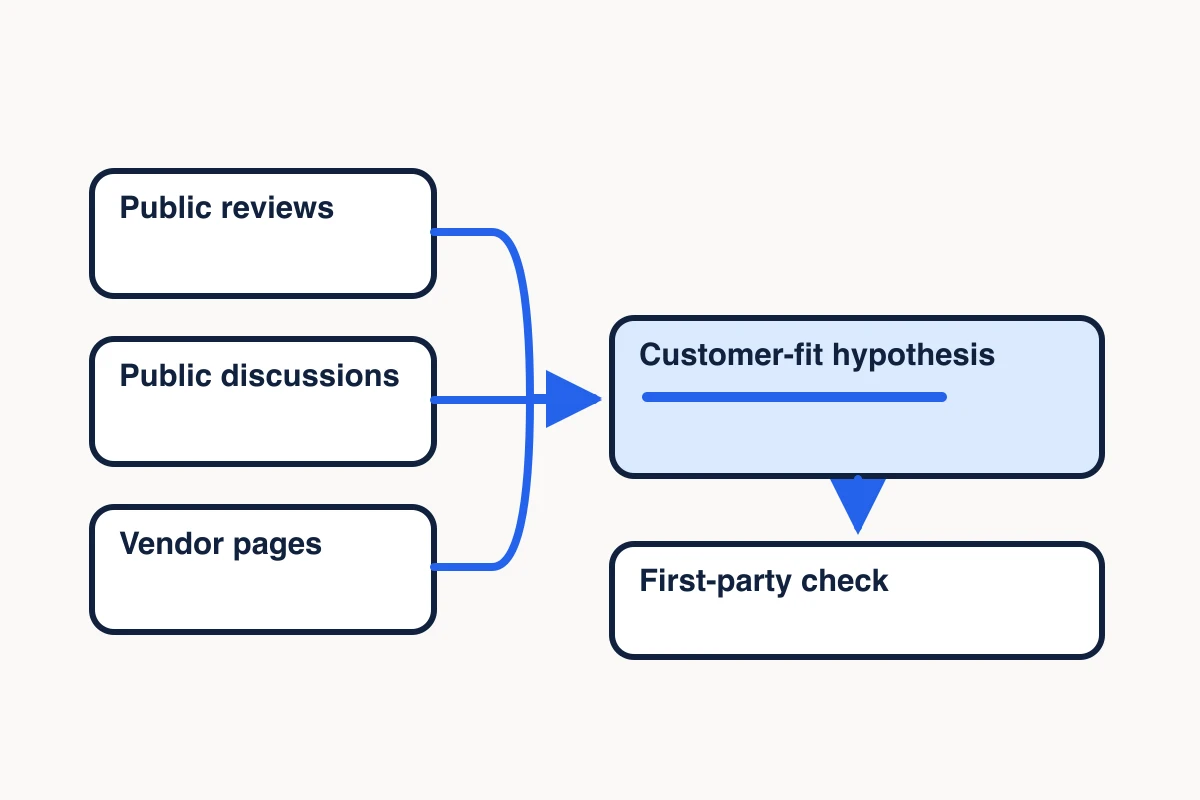
An ideal customer profile (ICP) describes the type of account or customer that is a good fit for a specific offer. Public reviews, company pages and buyer discussions can help you see what people need and where existing tools fall short. Use that evidence to write a working profile with rules your team can check.
Suppose your agency offers SEO research for teams that publish across several markets. “Growing marketing teams” gives you little to qualify. A better question is whether a prospect regularly compares search results across markets and needs to show a client where each recommendation came from. That gives you an account trait to look for and a reason it matters.
Define the offer and customer fit you need to test
Start ICP research with one offer, one candidate segment and one decision. Write what the offer helps customers do, what they need in place to use it and what would make the engagement a poor fit. If you plan to use the profile for lead qualification, name the facts you could check in a discovery call or account record.
For a service that turns web evidence into client briefs, a team with recurring research and source requirements is a candidate segment. Frequency matters because it tells you whether the workflow will be used again. A buyer persona addresses a different level of the decision. It describes a person involved in the purchase, their responsibilities and the proof they need. Keep the ICP focused on the account and its situation.
Choose public sources and set a sample boundary
Choose each public source for a question it can answer. Company service pages show what a business says it offers. Reviews and public discussions can describe why somebody tried a tool or struggled with it. Search results help find those sources. Open the original page when you need the complete wording or context. Search results versus page extraction
Set the scope before gathering records. Note the products or accounts you selected, the dates, the source types and any sort order you can see. Include favorable and critical experiences. A positive review can explain what made a workflow usable. A critical one can reveal conditions a tool needs to meet. Keep repeat posts or syndicated copies together so one experience does not appear to be several.
With MCP Scraper, use Google search for discovery, page extraction for a selected public URL and Google Maps collection for reviews attached to a specific listing. Check that you opened the intended listing or URL and that the results contain the fields you need. Record failed or missing sources in the same ledger as the returned records. Google Maps scraper
Record source evidence before interpreting it
A useful ICP research ledger keeps each observation traceable. Give the row an evidence ID. Save the exact source link, what you requested, what came back, when you captured it and which date the source displayed. Write a short observation in one field and any possible interpretation in another. Mark fields you cannot verify as unknown.
A published MCP Scraper example requested up to five review cards from the Formula Roofing and Remodeling listing in Denver. It returned five. One card showed a five-star rating and a relative date of “5 months ago” at the time of capture. The public sample records the exact listing, capture time and requested and returned counts. Keep the relative date as displayed unless you can verify the exact review date. Download the captured example
| Field | Entry |
|---|---|
| Source | Formula Roofing and Remodeling on Google Maps. See the captured example above. |
| Capture and scope | November 7, 2026 at 04:35:29 UTC. Five review cards requested and returned from one listing. |
| Observation | One example card displayed five stars and “5 months ago.” |
| Interpretation | The card records a positive rating. |
| Purchase trigger | Unknown. Ask what prompted the customer to look for a roofer. |
Formula Roofing lists residential and commercial roofing. The review gives you a positive rating and leaves buyer type and purchase trigger unknown. If you have permission, check the matching estimate intake or ask the customer what kind of property it was and what prompted the request. If the record identifies a commercial property, keep that observation out of the homeowner sample. Leave either field unknown when you can’t verify it.
Turn customer observations into ICP qualification signals
An ICP qualification signal is an observable fact that helps you decide whether an account may fit an offer. To propose one, ask what job the observation reveals, why that job matters to fit and how a person on your team could check it.
In MCP Scraper’s category research, an Apify reviewer described using scraped material for paid-media audience research and reported duplicates and missing field documentation in a September 29, 2026 Trustpilot review. Another Apify reviewer described an AI-linked workflow moving to a more expensive route without an upfront check in an October 5, 2026 Trustpilot review. MCP Scraper captured both Trustpilot reviews on November 7, 2026. The individual links did not open in our November 10 check. See the November 7 capture notes for a paraphrase of each report and its original link. A Firecrawl reviewer wanted to look up attributes missing from an initial extraction in a December 23, 2025 Product Hunt review by Pranav Pai Vernekar. These are individual reported experiences. Together they suggest questions worth testing about recurring research, evidence quality and cost visibility.
For a scraper that helps teams assemble briefs from public sources, validate agency teams that repeat client research before teams that only need a one-off lookup. The public reviews point to work involving several records or missing fields. They give you a reason to test the recurring workflow first. They leave the reviewers’ account fit, budget and willingness to buy unknown.
| Candidate account | Evidence to request | Pilot decision |
|---|---|---|
| Agency with recurring client research | A recent brief the team can share, its required source fields and the date the task repeats. | Test first if the team can name a recurring deliverable and show what its reviewer needs. |
| Team with a one-off lookup | The exact source and the decision that depends on it. | Leave it lower priority while a single lookup solves the job. Reconsider if the work repeats or missing evidence changes a decision. |
Reverse that order if the agency already gets the source evidence it needs from its current process and the other team shows a recurring gap. Check the workflow in a recent deliverable before treating either account as a fit.
Keep the denominator with any count. If three of ten selected reviews mention missing fields, write “three of ten reviewed records.” Public reviews reflect who chose to post and what you selected. Market size, willingness to pay and typical outcomes need their own evidence.
Test ICP hypotheses against first-party evidence
A working ICP gets stronger when its qualification signals agree with evidence about accounts you know. Where you have permission, compare the proposed signals with customer interviews, closed-won and lost deals, repeat usage and retention. Look at accounts that had the proposed signal and still struggled. Check whether a different factor, such as access to the required source or an internal approval step, explained the outcome.
Write a decision for each signal. Keep it if it helps explain fit across the evidence you have. Narrow it if it only applies to a particular workflow. Leave it open if you have no way to check it yet. A marketer with no CRM access can hand over a working profile and a short list of interview questions for the client to validate. Further reading on ICP validation
Record account fit and buying timing separately. If the agency confirms that client briefs regularly need checked source links, mark it as a candidate fit. If it has no upcoming brief or specific collection problem to test, leave buying timing unknown. Recheck when the agency has a dated brief or a collection problem that a scraper pilot can address.
For a first scraper pilot, use one public source from the upcoming brief. Agree on the fields a reviewer needs, record any field the scraper leaves blank, and ask a teammate to reopen the original source before using a finding. If the source or required fields cannot be checked, keep the account fit provisional and test the missing prerequisite. Choose a first scraper test
| Field | What to record |
|---|---|
| Offer and candidate account | Source-backed SEO briefs for an agency with recurring client research. This is a hypothetical example. |
| Evidence and observation | Record the ID and date of an authorized brief or interview. Note which source fields the reviewer needed and when the work repeats. |
| Proposed fit rule | Test whether the team can name a recurring deliverable and explain why the source fields matter. |
| Counterexample | Record an account with similar work that struggled, or one that already had the evidence it needed. Note what explains the difference. |
| Fit and buying timing | Keep fit provisional while checking the rule. Record buying timing separately and leave it unknown until the team identifies a dated brief or collection problem. |
| Next scraper check | Collect one public source for the brief. Record missing fields and ask a teammate to reopen the original source before using the finding. |
Save and revisit the ICP evidence
Save the ICP and its evidence ledger as separate records. The ICP should tell the team which accounts to prioritize and how to check the criteria. The ledger should let another researcher reopen the source, see what it said and decide whether the interpretation holds. Record what changed when new interviews or account data revise the profile.
If you use an AI assistant to group observations, ask it to return the evidence IDs for each proposed theme, list conflicting examples and leave unsupported fields blank. Read the underlying sources before adopting a qualification rule. When another research session will need the material, you can deliberately retain the selected sources in Memory Vault and verify retrieval with the next research task. Saving scraped research in Memory Vault
Sources
- Audience research review.https://uk.trustpilot.com/reviews/6abc0d1b6edda7e3783f4f2c
- Cost visibility review.https://uk.trustpilot.com/reviews/6ac3bbbb6295e5513ef1c401
- Extraction review source.https://www.producthunt.com/products/extract-by-firecrawl/reviews
- Further reading on ICP validation.https://www.salesforce.com/sales/ideal-customer-profile/
Inspect the review evidence behind the example
See the requested and returned counts, a review excerpt, and the source listing from one Denver roofing capture.
See the captured Maps review example