 MCP Scraper
Key takeaways
- A tracked prompt is not one answer. At SE Visible it is about 150 answers a month on the Basic and Core plans and 180 on Agency; at Ahrefs it is 30 checks a month for each platform tracked daily1, 3.
- Per answer, SE Visible's Agency plan lists the lowest figure of the six we worked out, $0.0022; an Ahrefs extra check is $0.020, and a Claude update there uses 8 checks1, 3.
- An MCP Scraper mention check is 20 credits a run and a full fan-out is 80, about $0.0025 to $0.0030 and $0.010 to $0.012 at the published plan prices5.
- Fan-out shows the work behind an answer. One signed-in ChatGPT answer we captured ran 2 searches, looked at 71 pages and cited 166.
- Your site has three outcomes in an answer, not two: cited, looked at but not cited, or absent. The middle one is where content work starts.
- The trackers run on their own schedule, keep a live dashboard and cover more engines in one place. MCP Scraper does none of those three: you run each check, the results go into tables, and a finished report page, with a PDF on request, is made when you ask for one7.
In this article
- Why compare AI visibility trackers by the answer, not the prompt?
- What does one answer cost at each tracker?
- Mention tracking and fan-out answer different questions
- What does one answer contain, assistant by assistant?
- Cited, looked at, or absent: the three outcomes for your site
- A small tracking batch, and why answers change between runs
- What each AI visibility tool checks, side by side
- What the trackers include that MCP Scraper does not
- What does an MCP Scraper AI visibility report look like?
- When do you want both kinds of check?
- How we measured
- Where to go next
- Frequently asked questions
- Sources
SE Visible works out at $0.0022 to $0.0079 an answer depending on the plan, Ahrefs Brand Radar charges $0.020 for an extra check, and the two MCP Scraper checks come to about $0.0025 to $0.012 at the published plan prices1, 3, 5. The fan-out record keeps the smaller searches the assistant ran, the pages it looked at, the pages it cited and the kinds of site it leaned on.
We compared three products on one unit, one answer: one question, asked of one assistant, once. A monthly price per prompt hides that unit, because a "prompt" at one vendor is five assistants checked every day and at another is one. MCP Scraper is one of the three, so every competitor figure below is taken from the vendor's own page, with the page and the date, and the things the trackers do that MCP Scraper does not are listed plainly.
Why compare AI visibility trackers by the answer, not the prompt?
Compare by the answer because a "prompt" means a different amount of work at each vendor. SE Visible's Basic plan lists "75 prompts tracked daily" and "~11,250 answers per month" on five engines, which is 150 answers for each prompt1. Ahrefs says "Each prompt is checked daily on every selected platform. 5 prompts on 1 platform = 150 checks/mo."3 That is 30 checks a month for one prompt on one platform.
So a price per prompt tells you little until you multiply it out. One SE Visible prompt is five assistants every day. One Ahrefs prompt is one platform every day, and you choose how many platforms. One MCP Scraper run is one assistant once, when you run it.
The number that compares across all three is the price of one answer. It also maps to the question you are paying to answer: what did this assistant say, this time, to this question?
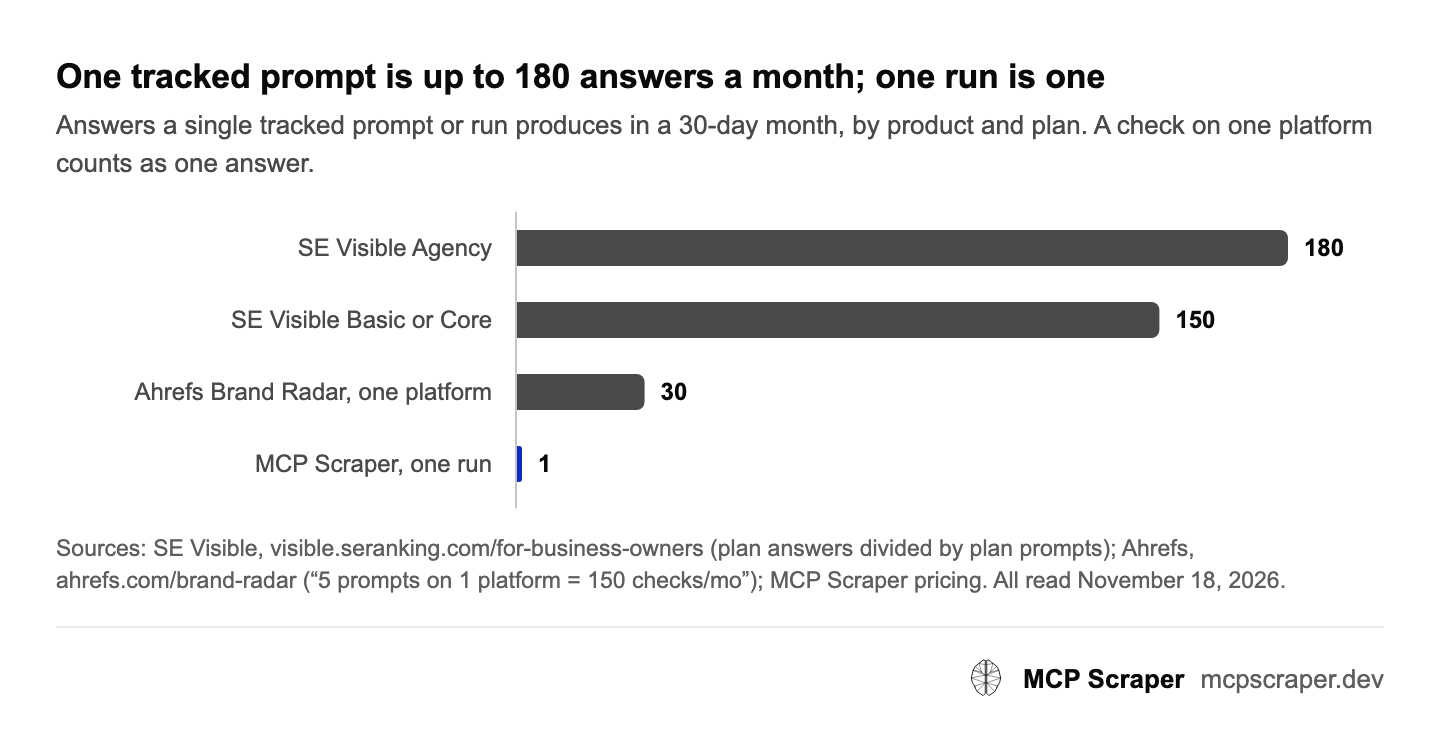
The difference matters most when you track few questions on many assistants, or many questions on one. A tracker that bundles five engines is good value if you want all five; if you only care about ChatGPT, four fifths of each prompt's answers are on engines you do not read.
What does one answer cost at each tracker?
One answer costs $0.0022 to $0.0079 on SE Visible's plans, $0.020 as an Ahrefs extra check, and 20 or 80 credits in MCP Scraper, which is about $0.0025 to $0.0121, 3, 5. These are list prices for monthly billing, read on each vendor's page on November 18, 2026.
- SE Visible. Basic is $89 a month for about 11,250 answers, Core $189 for about 30,000, Agency $399 for about 180,0001. Divided out: $0.0079, $0.0063 and $0.0022 an answer. With annual billing its pages show "Annually Save 20%" and the lower prices $71, $151 and $3192.
- Ahrefs Brand Radar. Custom prompts start at $50 a month, and the page lists "Overage $0.020/check billed monthly"3. One check is one prompt on one platform once, so an extra answer is $0.020. "Claude consumes 8 checks per update."3 An extra Claude answer is therefore $0.16 at that rate.
- MCP Scraper. A mention check (signed-out ChatGPT or Gemini) is 20 credits a run and a full fan-out (signed-in ChatGPT or Claude) is 80 credits a run; failed runs are not charged5. A credit is $0.00015 on Starter ($12 for 80,000) and Growth ($40 for 266,667), and $0.000125 on Scale ($100 for 800,000)5.
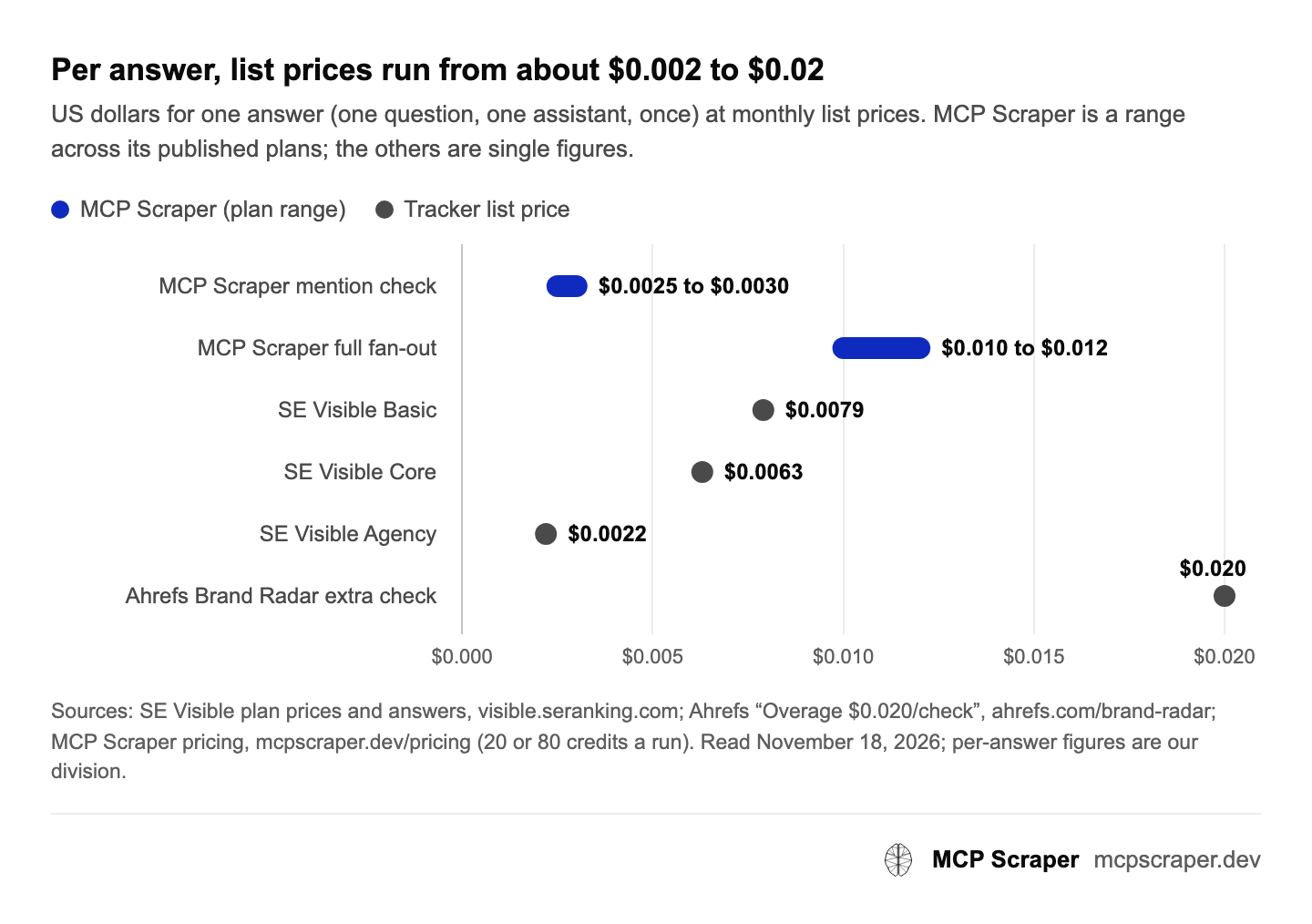
Read the chart both ways. Per answer, SE Visible's Agency plan is the lowest figure here, and a full fan-out costs more per answer than any SE Visible plan. The smallest purchase differs too: SE Visible's smallest plan is $89 for about 11,250 answers a month, while one MCP Scraper run draws 20 or 80 credits from a plan that starts at $121, 5. Starter's 80,000 credits are 4,000 mention checks or 1,000 full fan-outs, from the same balance every other tool uses.
How the per-answer figures were worked out
Each vendor figure is the monthly plan price divided by the answers the vendor says the plan includes, or the vendor's own price for one extra check. The MCP Scraper range is the credit price on the published plans times 20 or 80; the $1 first month of Starter is left out because it is an introductory price. We did not divide Ahrefs' $50 starting price by a check count, because its page does not say plainly which check allowance that price includes.
Mention tracking and fan-out answer different questions
Mention tracking answers "did we show up?"; fan-out answers "how did the assistant build its answer?". Both start from the same answer, and they keep different parts of it.
A mention record counts names. For each brand you pass, MCP Scraper's brand_mentions says whether it was named, how many times, its order among the names, and the words around its first mention, matched by exact name. Trackers roll the same kind of record into measures such as mention rate, first-named rate, share of voice and cited rate, the measures MCP Scraper's tracker planner (rank_tracker_workflow) also lays out.
A fan-out record keeps the research. Ahrefs describes fanout queries as "extra questions that AI platforms generate when answering" a prompt4. When the assistant shows those searches, MCP Scraper returns them, with the pages it searched and the pages it cited kept apart, the passage quoted for Gemini and Claude citations, and a site type for each source: government, education, news, Reddit, forum, social and video, encyclopedia, review site, local directory, retailer, docs, competitor, first-party or other.
That second record is the one you can act on. A mention rate that drops says something changed. The fan-out says which search the assistant ran, which pages it read for that search, and whether yours was among them.
What does one answer contain, assistant by assistant?
One answer can hold dozens of pages the assistant looked at for every handful it cites. We asked "What are the best standing desks for a home office in 2026?" on three assistants on November 17 and 18, 20266:
- ChatGPT, signed in: 2 search queries, 71 pages searched, 16 cited, plus 6 product lookups and 1 image search, listed apart from the web searches.
- Gemini, signed out: 6 pages searched and 4 cited. Signed-out Gemini does not show its search queries.
- Claude, signed in: 4 search queries, 54 pages searched, 6 cited. A follow-up question ran 3 queries, searched 43 pages and cited 7.
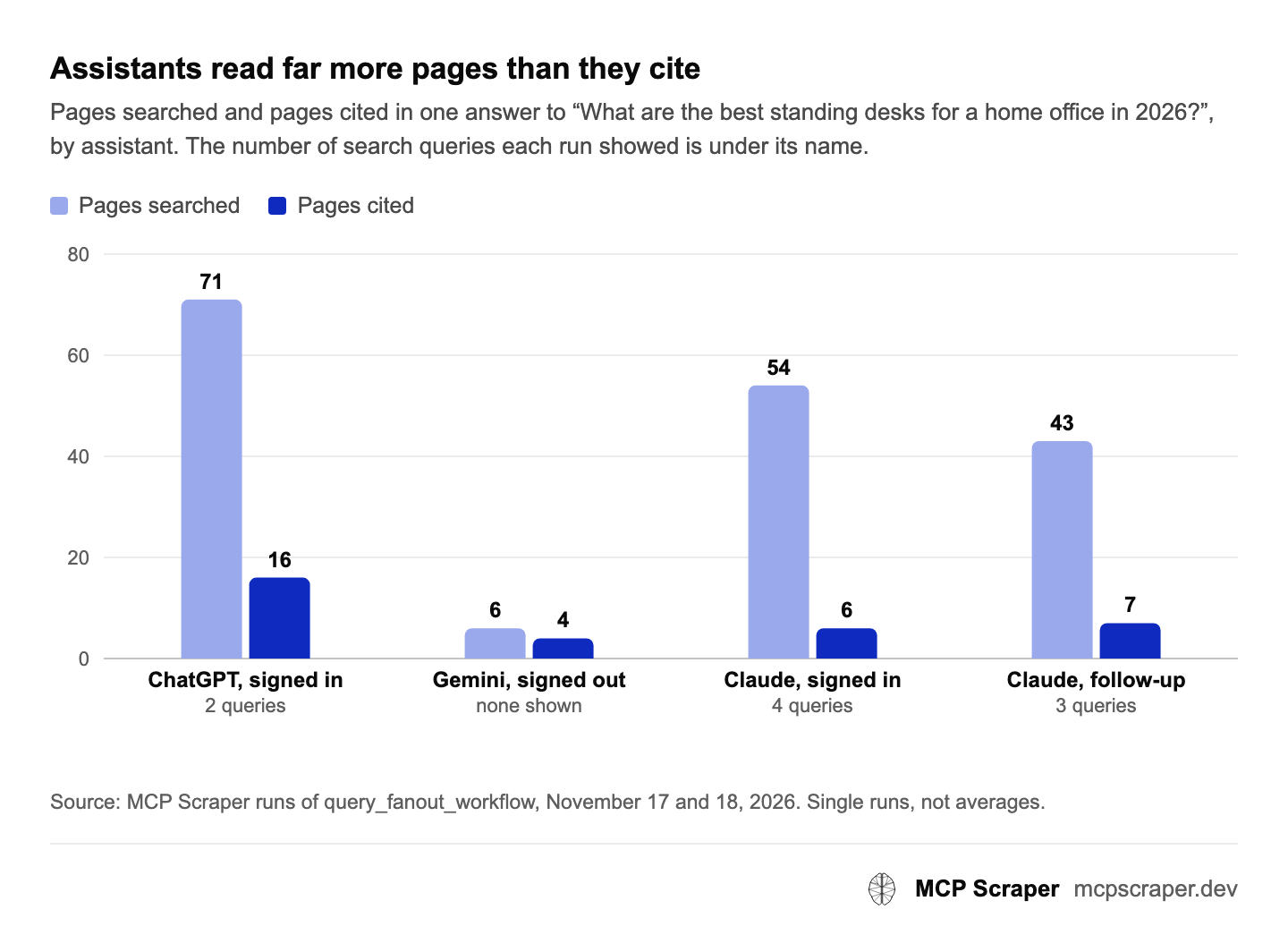
Two things follow. The assistants differ a great deal in how much they read before answering, so a single blended score hides most of what happened. And the queries are only visible on some runs: signed-in ChatGPT and Claude show them, signed-out ChatGPT and Gemini do not. Ahrefs shows fanout queries for ChatGPT and Perplexity and says "Most of the time we see two per prompt"4.
Speed differs as well. In our runs a signed-out Gemini answer took 11 to 14 seconds, a signed-out ChatGPT answer 12 to 26 seconds, and a signed-in ChatGPT answer with web research 55 to 69 seconds6.
Cited, looked at, or absent: the three outcomes for your site
In any one answer your site is cited, looked at but not cited, or absent. MCP Scraper's site_outcome returns which of the three for your domain and for each competitor domain you pass.
- Cited. The assistant linked your page as a source. This is what a citation count in a tracker measures.
- Looked at but not cited. The assistant opened your page while researching and used other pages in the answer. In the ChatGPT answer above, 55 of the 71 pages searched were in this group6.
- Absent. Your page was not among the pages searched at all.
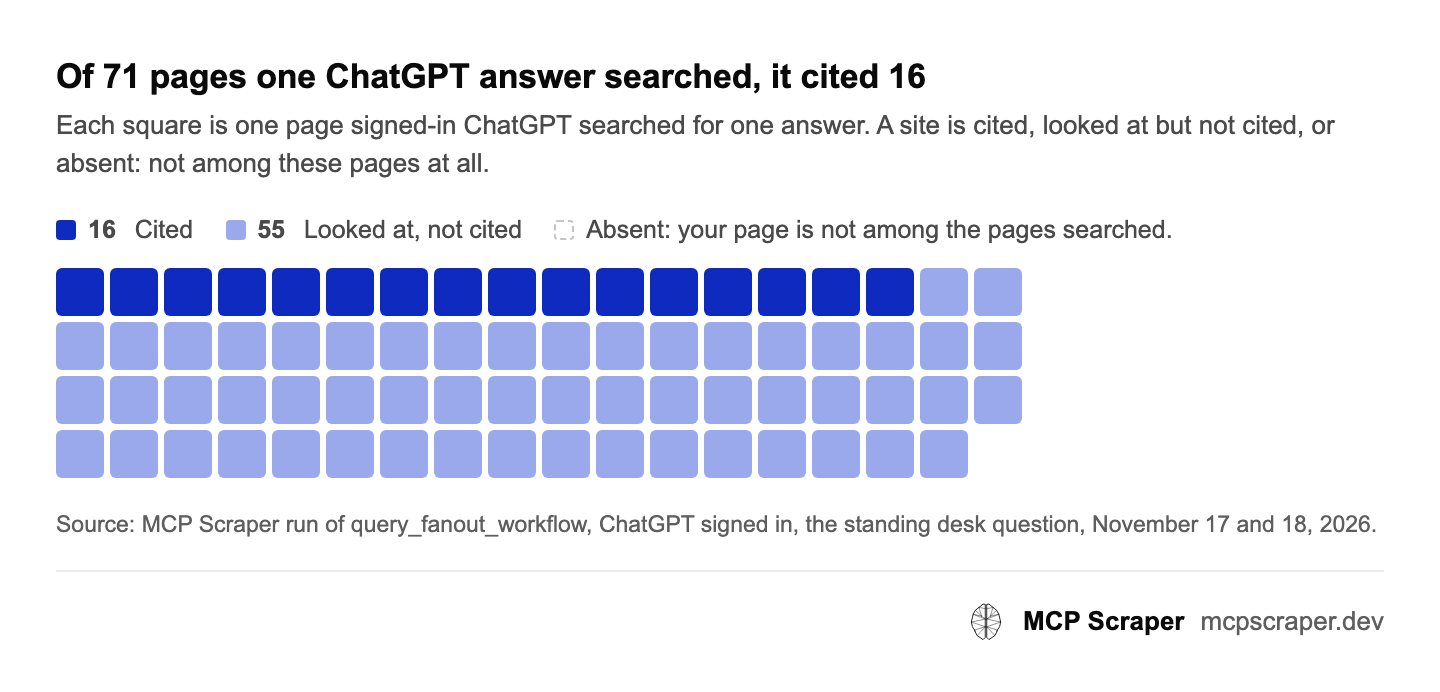
The middle outcome is the useful one. Your page reached the assistant's research and lost to other pages on that search. You can read the query it came from and the pages that were cited instead. Absent points somewhere else: to whether you have a page that answers the search at all.
A tracker that records only mentions and citations folds "looked at" and "absent" together. That is not a fault in the tracker; it is a different measure.
A small tracking batch, and why answers change between runs
One run is one sample, and the same question can come back different the next time. To show what a batch looks like, we ran 2 questions about roofing CRMs on ChatGPT and Gemini, twice each: 8 answers, with three brand names tracked, all 8 saved to tables, in our runs of November 17 and 18, 20266. It is an example of the output, not a measurement of those brands, so they are Brand A, B and C here.
- Brand A was named in 8 of 8 answers and named first in none.
- It held 18 of the 51 brand mentions, 35 percent.
- Its website was cited in 1 of the 8 answers.
- The same question asked twice on Gemini put the three brands in a different order each time.
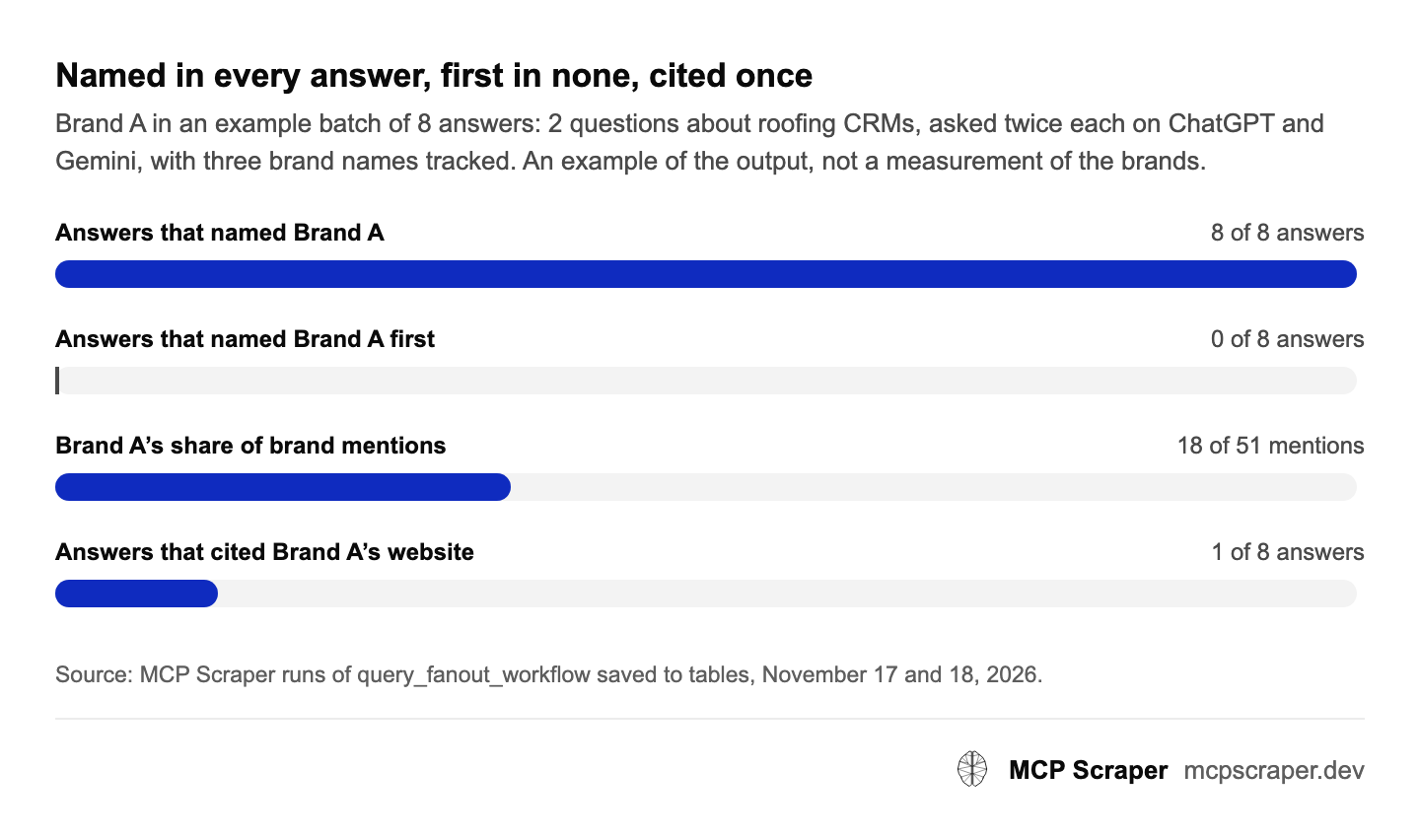
That last line is why trackers check daily and why a mention rate needs many runs before it means much. It is also why fan-out helps: when the order changes, the record shows whether the pages the assistant read changed with it.
What each AI visibility tool checks, side by side
Here is what each product says it records, as read on its own pages on November 18, 2026. "Not described" means the pages we read do not say; it does not mean the product lacks it.
| What is checked | MCP Scraper | SE Visible | Ahrefs Brand Radar |
|---|---|---|---|
| Assistants | ChatGPT, Gemini, Claude6 | ChatGPT, Gemini, AI Mode, AI Overview, Copilot; Claude on Agency1 | AI Overviews, AI Mode, ChatGPT, Perplexity, Gemini, Copilot; Claude in custom prompts3 |
| Brand mentions | Up to 25 names, exact-name match6 | Yes1 | Yes3 |
| Fan-out search queries | When the assistant shows them: signed-in ChatGPT and Claude6 | Fan-out page marked "Coming soon"2 | ChatGPT and Perplexity4 |
| Pages looked at, apart from pages cited | Yes6 | Not described1 | Not described3 |
| Cited sources | Yes, with counts6 | Sources AI platforms use1 | Citations3 |
| Quoted passage | Gemini and Claude citations6 | Not described1 | Not described3 |
| Site type of each source | 14 types6 | Not described1 | Not described3 |
| Runs on its own schedule | No: you or your scheduler runs it6 | Daily1 | "daily, weekly, or monthly"3 |
| Dashboard | No live dashboard: tables you query6 | Yes1 | Yes3 |
| Reports | A finished report page with charts, and a PDF on request7 | Data export to "add to reports"1 | "summaries, alerts, and reports on your schedule"3 |
| Price unit | Per run5 | Per plan, per month1 | Per check3 |
SE Visible's fan-out page describes what it plans to show: "Frequency, mention rate, and citation share sit on each query"2.
What the trackers include that MCP Scraper does not
The trackers run themselves, keep their results on a live dashboard and cover more engines in one place; MCP Scraper does not do any of the three.
- Their own schedule. SE Visible tracks prompts daily and Ahrefs lets you choose daily, weekly or monthly1, 3. MCP Scraper has no scheduler: your AI client's own scheduler, a cron job or you start each run.
- A live dashboard. Ahrefs invites you to "Build your perfect dashboard"3, and both trackers update their views on their own1, 3. MCP Scraper has no dashboard that refreshes itself: results are saved in tables (table-create, table-insert-rows, table-query), and a finished report page is made when you ask for one, as the next section shows7.
- More engines in one tracker. AI Mode, AI Overviews, Copilot and Perplexity sit inside the trackers1, 3. MCP Scraper's fan-out tool covers ChatGPT, Gemini and Claude; Google's AI Overview is read through its separate Google search tools.
MCP Scraper's own limits, stated as plainly: brand matching is by exact name, so a misspelling or a short form is not counted; answers vary from run to run; and Claude needs a saved signed-in profile, set up once. ChatGPT and Gemini need no sign-in.
What does an MCP Scraper AI visibility report look like?
It is one finished report page with charts, made from the measures your AI has already worked out, and it can be sent to a client as it is. MCP Scraper added it in version 1.7.0 on November 18, 2026, as the tool create_ai_visibility_report7.
The page holds the headline visibility with the count behind it, share of voice, visibility by assistant, a trend line, a competitor ranking, a question table, a topic table against competitors, what happened to the website (cited, looked at, absent), the kinds of site the assistants used, the top sources, the assistants' own searches, and written analysis with next steps7.
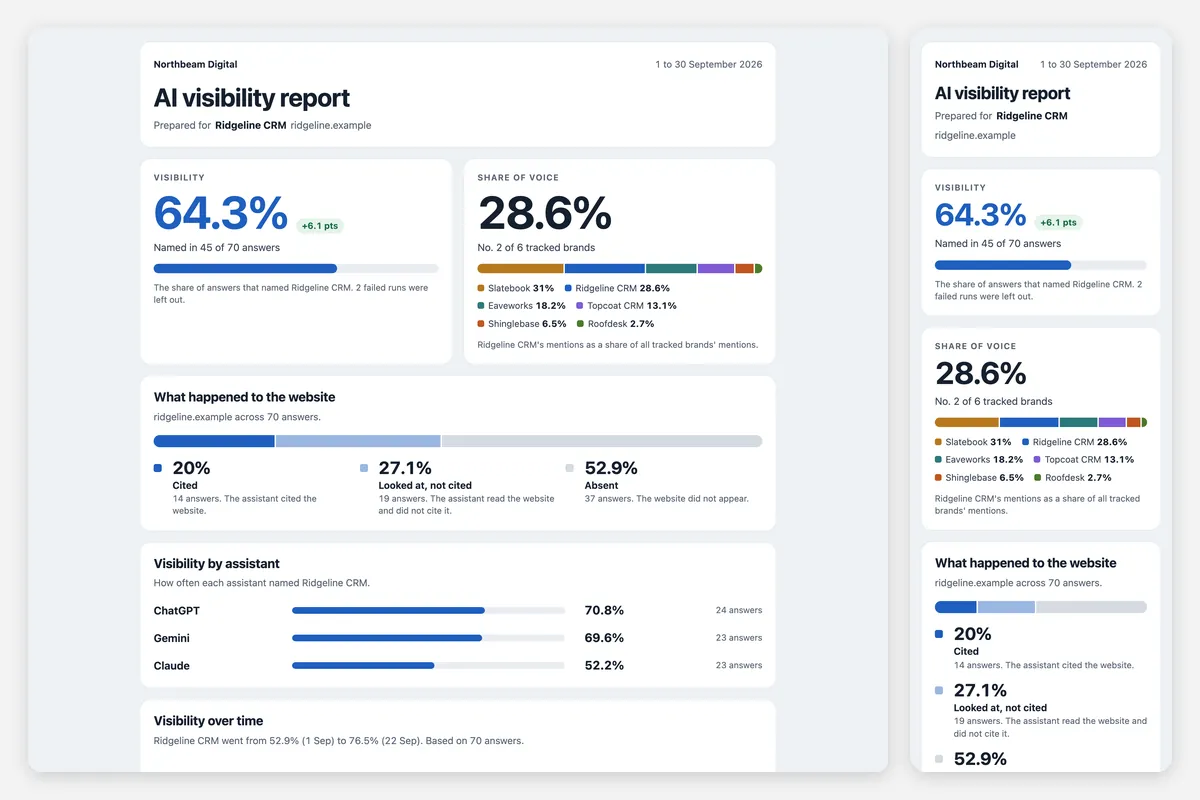
The report draws only the numbers it is given. Your AI collects the answers, saves them to tables and works out the measures first; the report then sets every percentage beside its number of answers and labels a figure from fewer than 10 answers as a small sample7.
- On a phone and on paper. The page works on a phone, is self-contained and prints cleanly. The example's PDF runs to 6 pages in US Letter.
- White-label. It carries the customer's colour and logos, not MCP Scraper's.
- Price. The report page is free. A PDF of it, made on the server in A4 or US Letter, is 10 credits, and a PDF that could not be made is not charged7.
- A guide. The free tool ai_visibility_report_guide explains each measure and includes a complete example7.
What it does not change: the report is made when you ask for it. It is not a dashboard that updates itself, there is still no built-in schedule, and the checks behind it still cover fewer engines than the trackers hold in one place.
When do you want both kinds of check?
You want both when you need a trend line and a reason. A tracker gives you the line: across many prompts and days, is the brand named more or less often? A fan-out run gives you the reason for one answer: which searches ran, which pages were read, and where your page stood.
A common split is to let a tracker watch the full prompt set and to run fan-out on the questions where the line moved or where a competitor is named first. MCP Scraper's tracker planner lays out the tables and measures for that work, and it collects nothing until you run the checks.
How we measured
Competitor figures were read on each vendor's own public page on November 18, 2026, saved as text, and checked word for word for every quotation1, 2, 3, 4. Prices are monthly list prices in US dollars before tax. Answers per prompt and price per answer are our arithmetic from those figures.
The answer contents and the batch are MCP Scraper's own runs of query_fanout_workflow on November 17 and 18, 20266. They are single examples, not averages, and a second run of the same question can return different numbers.
We compared three products because they are the ones whose prices, units and features we could verify on their own pages today. Other trackers, such as Otterly.AI, Peec AI, Profound and the Semrush AI Toolkit, publish their own plans; we left their figures out rather than repeat them unchecked.
Where to go next
The landing page shows how MCP Scraper checks an AI answer; the live product pages hold the tools, the rates and the setup.
- How MCP Scraper checks AI answers, step by step: AI visibility tracking with MCP Scraper.
- The search and scraping tools the AI answer check sits among: MCP Scraper's Scraper tools.
- Plans and the per-run rates: MCP Scraper pricing.
- The tool reference and setup: MCP Scraper docs.
- More guides on search, scraping and SEO research: the MCP Scraper blog.
Frequently asked questions
No source we read names one tool as best for every team, and we do not either. Compare tools on the price of one answer, the assistants you care about, and what each answer record holds: mentions only, or the searches and pages behind the answer too.
At list prices read on November 18, 2026, one answer costs $0.0022 to $0.0079 on SE Visible's plans and $0.020 as an Ahrefs extra check. In MCP Scraper a mention check is 20 credits and a full fan-out 80 credits, about $0.0025 to $0.012 at the published plan prices.
A prompt is a question the tracker asks for you on a repeat. At SE Visible one prompt is about 150 answers a month on Basic and Core, five engines every day. At Ahrefs one prompt is 30 checks a month for each platform checked daily.
Query fan-out is the set of smaller searches an AI assistant runs to research one question before it answers. A fan-out record lists those searches, the pages the assistant looked at for them and the pages it cited.
The trackers we read record citations, the pages an answer links. Neither SE Visible's nor Ahrefs' pages describe a list of pages looked at but not cited. MCP Scraper's fan-out tool returns the pages searched and the pages cited separately.
AI assistants do not answer the same way every time. In our example batch, the same question asked twice on Gemini named the same three brands in a different order each time, which is why one run is a sample and a mention rate needs many runs.
No. MCP Scraper runs each check when you or your own scheduler starts it, saves the results in tables, and turns them into a report page or a PDF when you ask. Trackers such as SE Visible and Ahrefs Brand Radar run on their own schedule and show the results on a live dashboard.
Sources
- SE Visible (SE Ranking), "SE Visible for Business Owners", read November 18, 2026. Open source
- SE Visible (SE Ranking), "Query Fan-Out Tool: See AI Sub-Query", read November 18, 2026. Open source
- Ahrefs, "Brand Radar", read November 18, 2026. Open source
- Ahrefs Help Center, "How to view fanout queries generated by AI", read November 18, 2026. Open source
- MCP Scraper, "Pricing", read November 18, 2026. Open source
- MCP Scraper, the MCP Scraper team's own runs of query_fanout_workflow on November 17 and 18, 2026, and the tool's output fields as released in version 1.6.0 on November 18, 2026; the run records are not published, and the tool reference is in the docs. Open source
- MCP Scraper, "Turn AI answer tracking into a report you can send to a client" (release 1.7.0), November 18, 2026. Open source